Search This Blog

Wednesday, November 28, 2018

Stop the Bleed. Shark VS Swimmer.

It's been two months since Cape Cod experienced its first fatal shark attack in 82 years. There has been a steady increase in the presence of Great Whites each summer. The number of Great Whites spotted off the Cape in July was at 149. More than double how many were sighted in July of the previous year! In past years, June and July were considered the "slow season" for White Sharks with the increase in sightings happening in August, September and October.

 With these recent attacks, tourists who regularly visit the Cape every summer may consider relocating to different areas for vacations. Some surfers have even decided to wait until winter to go surfing to be safe. This change factor certainly is a concern for the future of Cape Cod economy. 


Image result for shark warning signs cape cod


Shark safety is on every towns mind this off season.  Researchers are actively holding town hall meetings to address concerns and provide facts and educating.  Educating a scared public is difficult and selectmen who are quick to appease the towns in which they serve.  The most recent proposal for shark safety came last week from the town of Chatham.  Town selectmen endorsed a proposition to install shark netting and other barriers around one of its most popular beaches, Oyster Pond. The idea is that these nets will provide a safe designated swimming area for beachgoers, preventing sharks and seals from coming close to shore. 

Australia and South Africa have already tested and are using shark netting on a beaches of their own. Although these net installations have succeeded in keeping some sharks away, they've also been heavily criticized due to the deaths of sharks and other marine mammals as a result of entanglement. This is a clear example of an ineffective strategy, because it hasn't worked to the extent in which humans can coexist with the ocean without harming its inhabitants.


Related image


 The Atlantic White Shark Conservancy has led to local communities to take extra precautions at beaches that won't endanger the marine life. These include warning signs, purple shark flags on lifeguard chairs, research boats that raise a flag if they're tracking a shark nearby, and even spotter planes/helicopters that fly along the coast to locate and report shark sightings. The shark is sighted and the pilot radios it's location to the harbor master who then closes a beach for safety. The hope for the continuation of tagging sharks will allow for increase of buoys for pings to be picked up and notification of sharks in local waters.  While all sharks cannot be tagged, the aim is to tag as many as possible to see if there are local residence White Sharks.  Research does support that Cape Cod does have "locals" in the water.


Image result for cape cod spotter plane

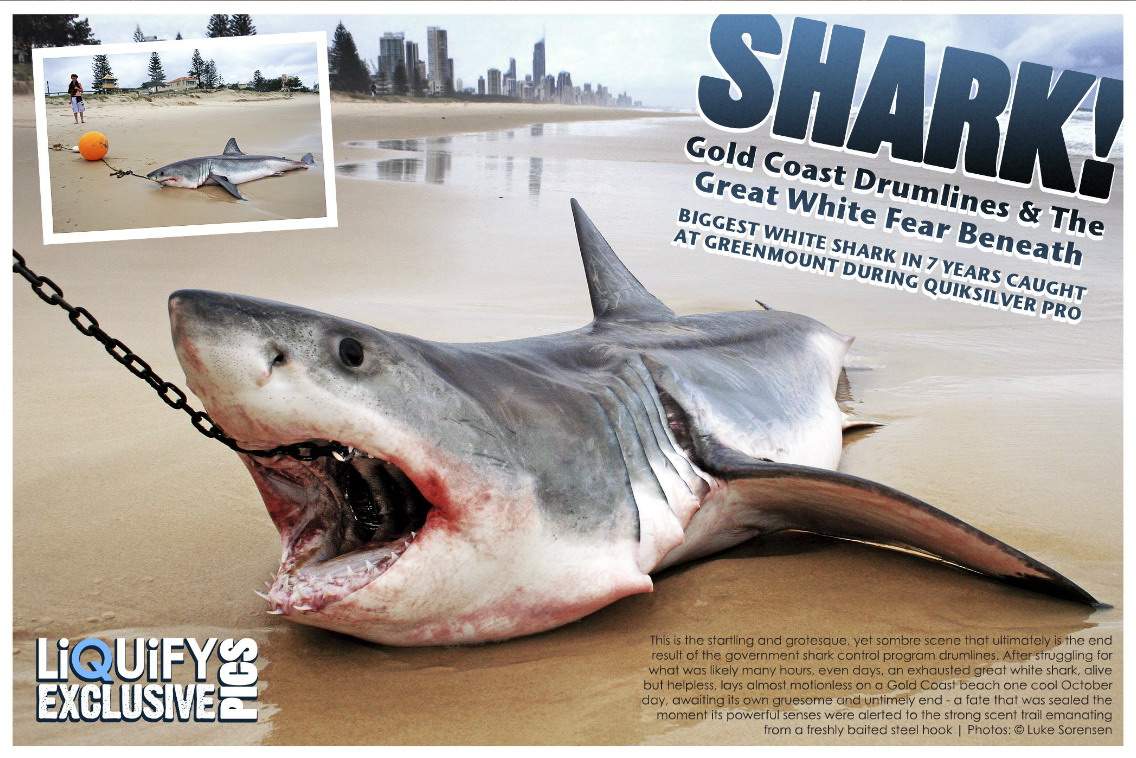
Perhaps the most controversial method of drawing sharks away would be through the use of drum lines. For those people who aren't familiar with the traditional drum-line, it's a trap that's designed to lure in sharks using baited hooks. And much like the idea of shark netting, this idea has been effective in keeping sharks away from people, but has nevertheless resulted in a large number of unnecessary shark deaths from being stuck on the hooks. Only around 70% of marine mammals caught on drum lines end up being released alive. The sad thing is, these drum lines are often deployed with the intent of killing the sharks, which is why this practice has been heavily criticized by people who've insisted on banning them.
Related image

However, with the use of smart drum-lines, this can be done from a more conservative standpoint. The idea behind smart drum-lines is to be able to alert nearby wildlife rangers of a shark biting the line, with the use of an electronic magnet that triggers a signal when pressure is put on the line. This allows for a vessel to respond within 30 minutes of the incident. The sharks are then towed 500 meters further from the shore, and released. This method has proven to be much more successful, with around 99% of all sharks being released alive.

Image result for shark drumline


The use of nets or drum lines is certainly not a guarantee against a shark attack.  Culling seals and sharks is not a guarantee against a shark attack.  Marine Biologist have called Cape Cod "the Burger King rest stop on I 95" on the way to the Gulf of Maine and Canada. The know that some sharks to stay and hang out for the summer.  But, they also believe Cape Cod is just part of a "super highway".  Some proposals that will certainly be in the upcoming season is "Stop the Bleed" kits at every beach parking lot. Drone patrols and increased signage are also certain additions. 

'There are less than 100 attacks globally by sharks, and less than 10 percent are fatal. All it takes is one. It changes the way you think." Greg Skomal said at a town meeting at Nauset Regional Middle School on November 14.  

In addition to these warning methods, the Atlantic White Shark Conservancy has also promoted a training program known as "Stop the Bleed". This program is designed to medically train the public on how to treat a human flesh wound in the event that a shark attack occurs and there's no time to call for help. These safety methods will certainly help in the event a trained person is local at the next shark attack.  And there will be another. No doubt. 

Summer of 2019 should see an increase in many things. Awareness,  training, flags, signs, drones.... But, neither the marine biologists and scientists nor the selectmen elected to protect the welfare of their towns people, want to anyone bleeding. Shark or swimmer.


Friday, November 16, 2018

The Perilous Life of a Shark

Shark Conservation:

So far in the process of my research, there's one thing that has been clearly established. The perception towards sharks by humans is almost entirely due to their lack of awareness toward shark behavior. The movies only show us what sharks do to humans. But do are they aware of what humans do to them? The next step in this area of research for me will be to focus on the human activities that have directly led to the demise of these now endangered animals.

A new phenomenon and obsession with sharks have become surprisingly popular amongst our society today. Shark silhouettes and varieties of sharks are proudly promoted on t-shirts, bumper stickers, sport team logos, etc.

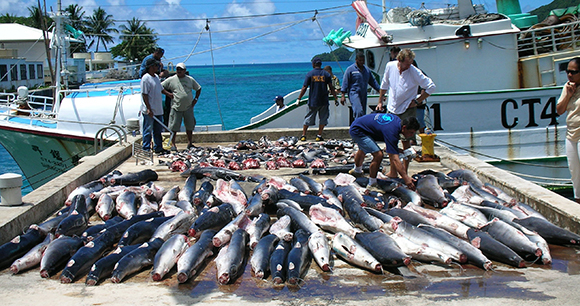
But did you know you can find them on a menu? That's right. Restaurants in many parts of the world include endangered shark species on the menu. Not for the whole shark, but only for the fins, to make shark fin soup, a popular dish in certain Asian countries. This involves fishermen cutting off the fins of the sharks and then tossing their bodies back into the ocean, leaving them to die. This is unfortunately a practice of cruelty that is accepted in many parts of the world where shark fin soup is considered a delicacy.

Image result for shark fin soup

Shark fin soup originated in the Ming Dynasty in the 14th century. Originally enjoyed by the nobility and aristocracy, as sharks were rare and hard to catch. During the Qing Dynasty of the 18th & 19th centuries more and more people began to consume shark fin soup. The increase in commercial fishing and trade during this time only increased the availability of the fins. It was then that Chinese traditional medicine made it part of the treatment for many ailments.  Shark fins, in Chinese medicine, are believed to prevent cancer, heart disease, lower cholesterol, improve all major organs.

When the Chinese economy boomed during the mid 80's, the demand shark fin soup more than doubled. As a result, so did the hunting of these animals, leading to a rapid depletion for some species by 95% over the next two decades. Fishermen in Asia have been noteworthy of being secretive about overfishing sharks. This is why it took so long for the people of China to figure out where this dish came from. A recent poll showed that roughly 75% of Chinese residents didn't know that soup meat came from sharks, as it's simply referred to as "fish wing soup" in most cases. 19% of these people also thought that shark fins would grow back.

Image result for shark finning regulations

Once people saw the damage this was doing to the shark populations, China prohibited the serving of shark fin soup at state banquets, while also banning the importation of shark fins into the country by air carriers. Today, a total of 21 countries, including the US, have restrictions against shark finning. Yet it hasn't been enough to lower the demands in China and Vietnam, both of which still pose a clear threat to the future of sharks.
Related image

Shark are still known to be captured by illegal fishing vessels, often coming in with thousands of sharks per vessel. Fishermen are bringing the carcasses back so as to convince people that they're using the whole body of the shark as restaurant seafood. In reality, however, this has been proven to be a cover up, so they can de-fin the sharks later without people noticing.

Image result for shark fin soup

It's time that we start stepping up to the plate to put an official end to the continuous culling of these creatures. It's almost as if these people don't care about whether or not sharks are important toward the environment. They're just in it for the profit, as they know the demand for these animals is relatively high in the fishing industry, so they'll just go for whatever money-making opportunity they can get. That's something that has become a major problem in today's society. We only pay attention to how something will affect us right now, and ignore the effect it will have on us in the long run.

There is truly a need for humans to understand the seriousness of this problem. The killing off of sharks, mostly in Asian and Indonesian waters, although shark fishing tournaments around the world and close to home, does impact our immediate future. The balance of nature is fragile. Our oceans are vital to the worlds health. Our health. Yet, the ecosystem is taxed and stressed by pollutants, garbage, plastics, carbons, climate change.  The human impact that has continued to cut into the chain of the health and well-being of the oceans ecosystem needs to cease in order to rebuild.   


Monday, November 5, 2018

Do you need a bigger boat? Survey results from Sutton High School regarding White Sharks and vacationing on Cape Cod.


A key element to my year long research is to collect data from the public based on their perceptions and opinions as well as research from scientists and environmentalists. Therefore, for this week's blog I decided to set up a survey for Sutton Memorial High School, asking students and faculty (who vacation on the Cape in the summer) as to how they're opinions on White Sharks has changed in response to recent shark attacks along the Cape. Sutton is a small town in Central Massachusetts. This is a unique location for this survey. Over an hour to the closest entrance to the ocean, but a good majority of us visit the Cape every summer, like many towns in New England.


The idea for this survey was to understand public perception of the recent attacks and fatality. I wanted to learn what parts of Cape Cod people were most visiting and if the surge in White Sharks in the region of Cape Cod had any effect on them. Given the media coverage of White Shark attacks and recent fatality I wanted to determined how it effected vacationers. In some cases, Great Whites may tend to congregate in one particular area more than others, and depending on how deep people go into the water, that may have an affect on their vulnerability to these apex predators.


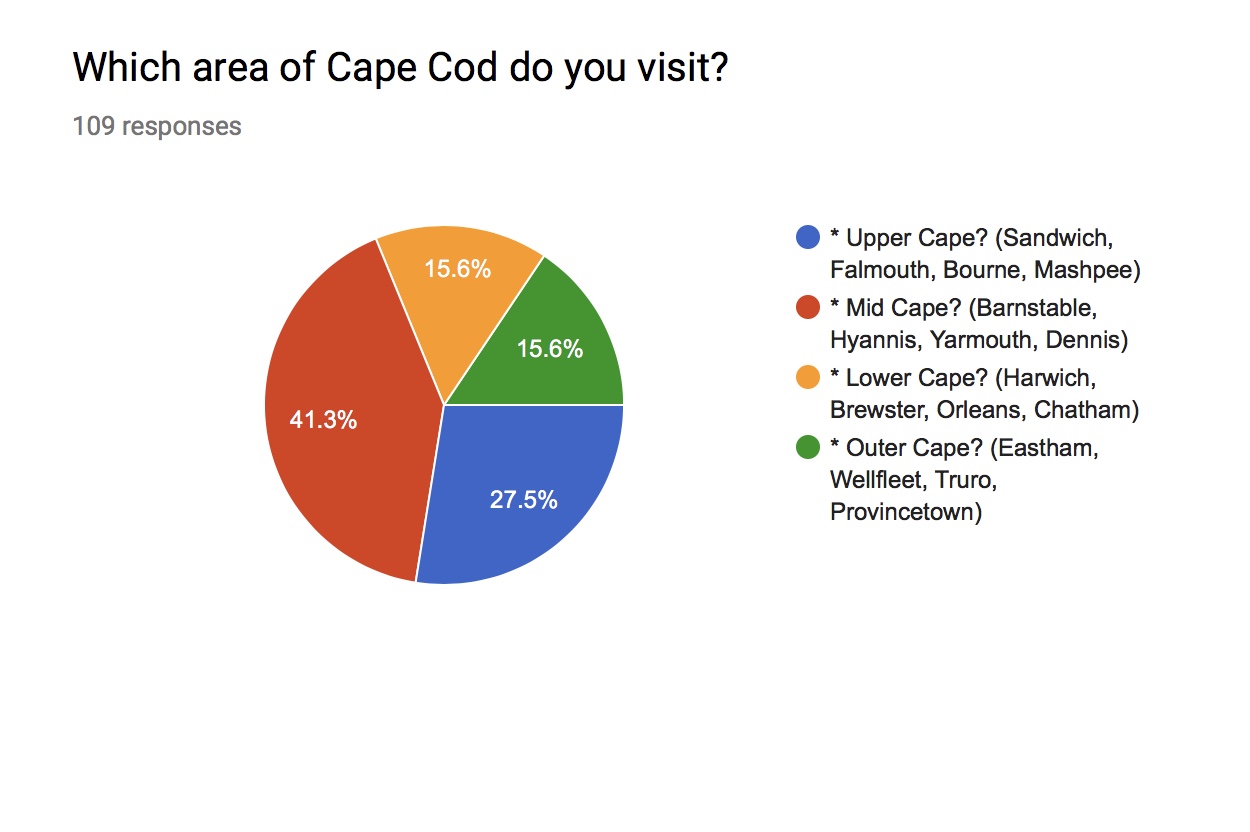
My survey resulted in collecting 109 submissions.  Of the 109 submitted entries, 74 of those vacation on Cape Cod. These results  showed that most people aren't as afraid of sharks as you might think. Surprisingly a large percentage chose to go deeper than waist-level in the ocean. Another surprise was the casualness in thought as pertaining to White sharks before entering the water. While the majority did give it some consideration (5), I had expected the scale to be higher in the fear columns. When I asked as to whether their fear of swimming in the ocean had changed after the recent shark fatality, the responses were divided pretty evenly, with about half saying their fear increased, and the other half saying that it had no effect on them.
From the data on the Sutton residents who vacation on the Cape,  the Lower Cape and Outer Cape represented the minority. These areas are where most of these attacks have been occurring. You would think that the reason for these attacks in certain areas would be due to the fact that so many people are congregating in that particular area. But these charts prove otherwise.


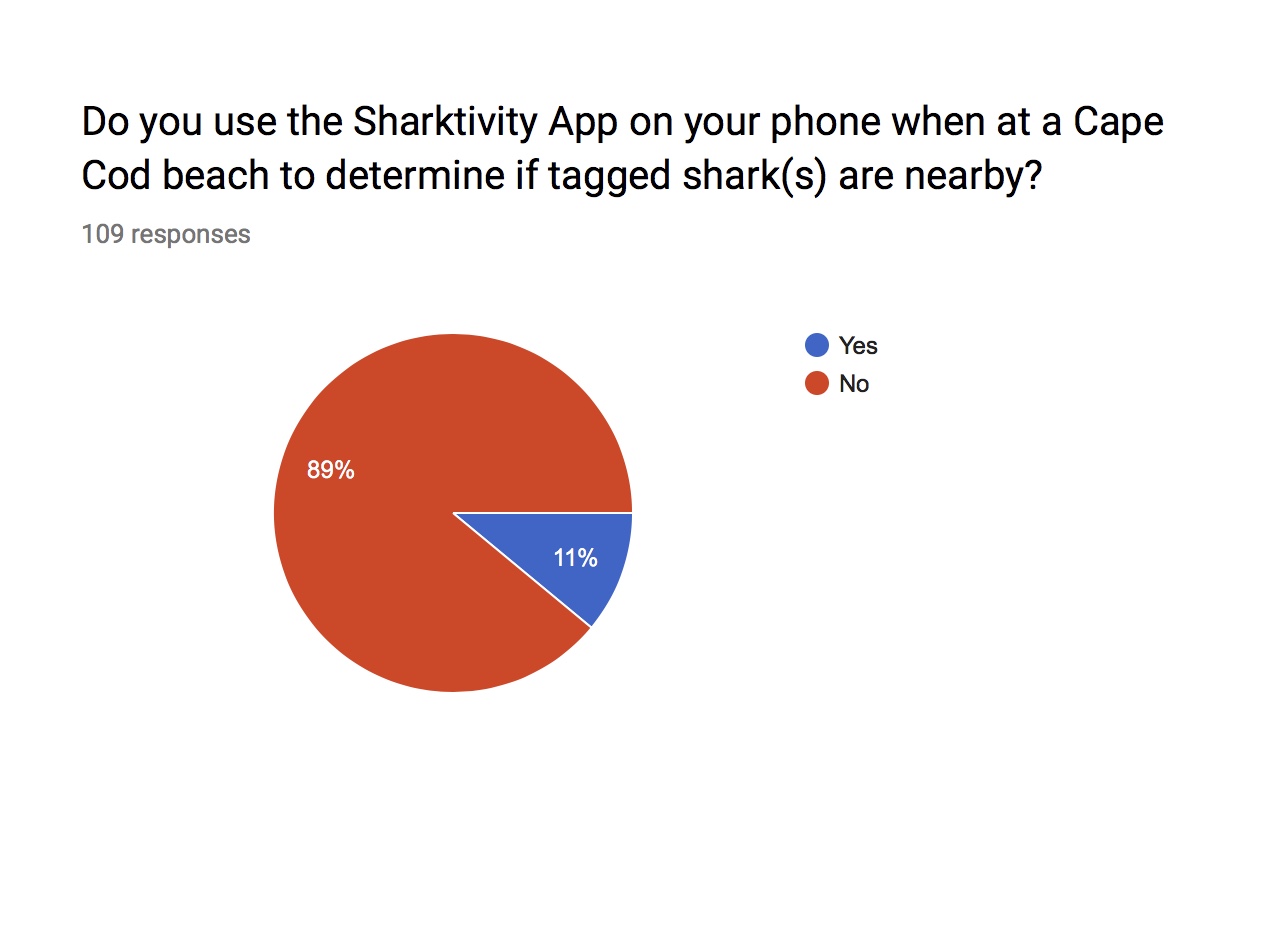
A easy resource, while not fool-proof, is the Sharktivity App. By downloading this app, one can check to see if any tagged White Sharks are in the vicinity.  While this is not going to show the potential for hundreds of other White Sharks that frequent Cape Cod, the 5 year study by Dr. Greg Skomal and the Atlantic White Shark Conservancy has managed to tag 18 sharks this season and 150 (at last count) since 2009.  The importance of this study has many components, but the importance of human safety is upmost.


However, my theory about the public being uneducated about these animals is proven true through my last question. "On a scale of 1-10, how much do you know about the importance of conservation of Great White Sharks?" More than 20% of people said 1 for their answer, implying that they're virtually unaware about the importance of Great White Sharks toward the environment. 

 The importance of the presence of sharks in our waters is an important and positive element to the health of the oceans ecosystem, but equally so, the need to address education of how to coexist and take the necessary precautions in their habitat and treat them with the respect they deserve. 

Going forward, my main objective is continuing to educate my audience on the importance of White Shark conservation as well as the current climate and events that White Sharks have on Cape Cod. 

Thursday, October 25, 2018

Da-dum...Da-dum....Da-dum da-dum da-dum da-dum.

The Jaws effect. 

"The single story creates stereotypes, and the problem with stereotypes is not that they are untrue, but that they are incomplete. They make one story become the only story."  
- Chimamanda Ngozi Adichie 


The author of Jaws, Peter Benchley has been quoted. "Knowing what I know now, I could never write that book today," he said, years later. "Sharks don't target human beings, and they certainly don't hold grudges. What I now know, which wasn't known when I wrote Jaws, is that there is no such thing as a rouge shark which develops a taste for human flesh, Benchley told the Animal Attack Files in 2000. He spent much of the rest of his life campaigning for the protection of sharks.

Afraid to go into the ocean? Fear of sharks seems to be part of human genes. Prior to the novel and film, sharks were visualized as a mystery predator under the sea with occasionally a fin cutting the surface in a zig zagging motion. But, the entire notion that a Great White Shark could have a thirst for human blood based on a fictional book was not a consideration. Until Jaws. A nerve had been struck. 

"Jaws" directed by Steven Spielberg.  Released June 20, 1975


Fear and trophy mania spurred by the single story and being almost decimated in the 1970's and 1980's - many scientists believe the Atlantic Great White shark population was reduced by almost 80%.  Jaws legitimized hunting sharks. And now they're status in nature has been put in jeopardy to the point where they will diminish if they're not protected. 

While a protected species in Federal waters of the Atlantic Ocean since 1997, it was in 2005 that regulations were passed in Massachusetts to make it illegal to capture a Great White Shark.  In 2015, regulations were passed to make it illegal to actively go out and attract Great Whites.  

Great White Sharks growth rate is much slower and they mature at a much slower than previously thought. According to NOAA Northeast Fisheries Science Center "With lifespan estimates of 70 years and more, white sharks may be  among the longest-lived fishes. Sharks that mature late, have long life spans and produce small litters have the lowest population growth rates and the longest generation times.  Increased age at maturity would make white sharks more sensitive to fishing pressure than previously thought, given the longer time needed to rebuild white shark populations." 


Why is this important to "the single story?" 

The answer is the ramifications of the "Jaws" effect, as a single story, allowed the normalization of great white shark fishing/hunting creating a crisis in population. The success in recent years of conservation education of the oldest and largest top predators of the world have been able to face the only one real threat.... us.


Monday, October 15, 2018

Marine Mammal Protection Act of 1972. The good.... The bad....The future.

Historically, grey seals and Great White Sharks inhabited Cape Cod waters hundreds of years ago. The gray and harbor seal populations were all but decimated in New England by the 1960's. The idea of a Great White Shark patrolling the waters of Cape Cod was conjured up from reading Peter Benchley's Jaws or seeing the film Jaws, in 1975. Today, seal sightings are normal and beach closings due to Great Whites snacking on a seal close to shore are common.


courtesy photo Claudia Linsley 


Any given day at The National Seashore you will see seals. Back in 2016 while vacationing with my family, we packed the car and headed out to The National Seashore in search of waves. The haze was burning off and the swells were increasing out on Marconi Beach. There was the customary sight of seals, in a row about 1/2 mile wide, floating and basking in the daylight just 20 or so yards off the beach. I grabbed my boogie board and headed out, keeping an eye out for seals. I caught a full wave to ride and jumped up on my board. Thirty seconds into my ride a large, dark grey shadow swam underneath me. Shock and awe. I rode the wave out with fear pounding my heart and exhilaration racing through my veins. I just had a close encounter with a really large grey seal in about 5 -6 feet of water. I exited the water. Quickly.


Clearly, the Marine Mammal Protection Act achieved incredible success with the resurgence of the grey and harbor seal population of Cape Cod.  With the success, the Great White Shark presence is consistent as well.  On any given day from late spring through fall, you can see a spotter plane in the sky or research vessels tracking Great Whites all along the National Sea Shore. Great White excitement can also lead to hysteria so it  is an important to educate the public on their importance to the ecosystem.  A healthy balance of phytoplankton to the apex-predators is crucial for the balance in the ecosystem of the Atlantic.  It is a race for scientists on developing the best technology and procedures to keep the public safe.

Related image
Monomoy Island Excursions, Trip Advisor


While some groups have advocated culling the seal population "There is very little evidence that culling seals will increase fishery yields or provide positive effects on the local ecosystem."  At the same time, Curt Nickisch reported the seals are popular with tourists and seal-watching boats are a booming industry.  Other scientists and environmental groups argue that even if culling of the Cape Cod population was to be attempted, there is significant reason to believe the Nova Scotia colony would repopulate the Cape Cod one. The surge in this seal population has also disrupted local businesses in the fishing industry, who've complained that the seals are eating their fish as they're hauling it in, resulting in less profit.


 Truro,  Head of the Meadow- courtesy photo: Chase Linsley

     The return of Great Whites to the Cape Cod region was a boom in the tourism economy. Every store seems to capitalized on the Great Whites image: from t-shirts to key chains. From dawn to dusk, hourly seal watch tours leave Chatham Harbor to take tourists to Monomoy Island.  Anxious at the prospect of seeing a Great White, tourists tepidly looked over the boat sides half wishing and half dreading the sight of a fin cutting through the dark water. Up until the recent fatal shark attack in August, the return of the Great Whites had been a tourism success. Will this now be it's downfall to the local tourism economy?


 Now, the co-existance is in a sensitive balance.

Approaching the end of a five year study, local and world renown marine scientist, Greg Skomal of the Atlantic Great White Shark Conservancy has been working with a team of researchers, tagging and collecting data Great Whites on the Outer Cape in order to track their migratory patterns. An important purpose that grew because of need for human safety from this study, is the Sharktivity App. This app for android or iPhone users can provide the public with realtime knowledge if a tagged Great White has been identified in the area. The public can check tagged sharks locations throughout the Cape. Human safety on the Cape will rely on a combination of awareness, technology and science advancement. 

Two thing are for sure. The grey seals are successfully repopulated and thriving and the Great White Sharks are Cape Cod residents.


Slow Response, but with Great Effect